So You Purchased an iPhone 18 Professional. Do You Nonetheless Want a Actual Digicam?
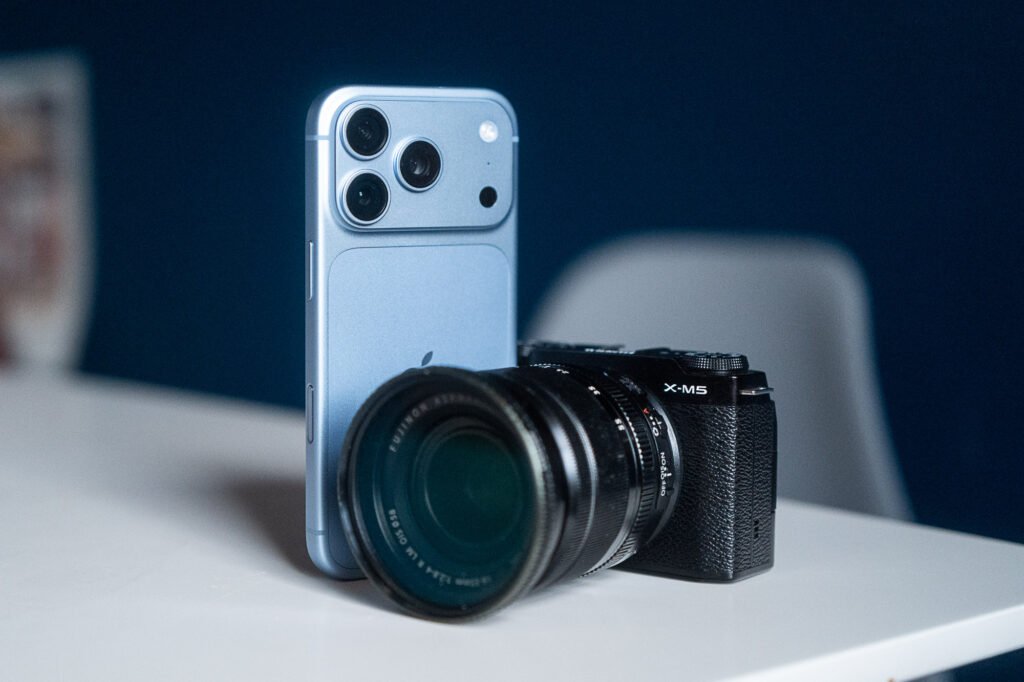
The iPhone 18 Professional is among the many most completed telephone cameras round, packing an array of sensors and lenses which can be all able to taking beautiful pictures in a wide range of circumstances. Throw within the new inventive tweaks to Apple’s Photographic Types and the iPhone 18 Professional turns into a formidable accomplice to severe photographers.
However how does it examine to an precise digital camera? To see why you’d decide one over the opposite, I took the iPhone 18 Professional on some photograph walks alongside Fujifilm’s X-M5, a compact-sized mirrorless digital camera with interchangeable lenses and a bunch of filmic profiles to select from.
This isn’t designed to be a direct comparability between every particular mannequin — in spite of everything, a telephone has different benefits past a digital camera, a few of which I’ll come to later. I’m not going to pixel peep at ultrafine particulars nor estimate which has the technically greatest dynamic vary. That is extra about which lets you be extra inventive and extra engaged in your image-taking and what every one presents.

Photographic Types vs. Fujifilm Recipes
With the iPhone 16 Professional Apple introduced its Photographic Types with the grid-like instrument for adjusting the colour tones and shadow depth for every of the seems. It was an enormous boon to iPhone photographers who wish to shoot with a particular look with out having to manually edit every picture after the very fact. Apple took that additional on the 18 Professional by bringing in additional superior instruments, together with the power so as to add picture grain and bloom to your pictures and giving handbook management over white steadiness. Lastly.
Fujifilm, in the meantime, has received the hearts of tens of millions of photographers the world over with the power to create filmic types that may be shared and put in as “recipes” on its cameras. Like Photographic Types, these seems change the whole lot from colour tones to movie grain and assist you to shoot with an nearly infinite array of filmic types with no modifying required.


In observe, each function in a lot the identical means. On the iPhone, I erred towards hotter types equivalent to Amber and Gold, bringing the shadows down and including some movie grain. My Kodak Gold-inspired Fujifilm recipes aimed to attain an identical impact and whereas they’re not an identical, I can’t say I like both of them over the opposite.
I don’t like all the iPhone’s types, however there are numerous Fujifilm recipes I don’t like both, and arguably this simply comes down to private style anyway. However I’ve seen that there’s quite a bit that Apple can do to enhance Types for photographers.
For one, you’ll be able to’t save a particular type as a preset to recall later. Whilst you can inform the telephone to recollect your last-used settings every time you open it, should you change these settings, you’ll want to recollect what they initially have been if you wish to return. It additionally means it’s tough to share these presets with others, whereas Fujifilm digital camera house owners have created an enormous group sharing recipes far and large.


General, Fujifilm’s recipes give a lot finer management over the look of your picture and make it simpler to recall a sure preset once you wish to begin taking pictures away. Each the iPhone and X-M5 (and certainly nearly all common cameras) additionally assist you to shoot pictures in uncooked format too, permitting you to use your individual edits afterward in apps like Adobe Lightroom, Snapseed or VSCO.
Telephone vs digital camera: Dimension and controls
The iPhone’s dimension makes it the dream digital camera for road or journey pictures the place it’s possible you’ll be strolling for miles on daily basis and don’t wish to be weighed down by tools. It simply slips into your pocket and will be whipped out simply as simply when inspiration strikes. Whereas Fujifilm’s X-M5 is small for a digital camera, with a lens on you’ll battle to get it right into a pocket, that means you’ll want a devoted digital camera bag to hold it round — or have it round your neck on a strap, which might develop into uncomfortable after a full day trip.
That’s doubly the case when you have additional lenses you’d wish to take with you, which the iPhone has inbuilt. Even Fujifilm’s endlessly common fixed-lens X100VI continues to be sufficiently big that you simply’ll solely handle to get it into a big coat pocket at greatest.

Then again, cameras are constructed to be ergonomic when taking pictures. Their bigger sizes offer you one thing to grip onto and maintain regular. By comparability, holding a thin iPhone when taking a photograph can usually really feel delicate, particularly once you’re attempting to not unintentionally press on the display screen. Personally, I don’t benefit from the really feel of taking photographs with a telephone, and it’s one of many the explanation why I’d all the time attain for an actual digital camera over a telephone for a day’s pictures.
That’s very true on the subject of adjusting taking pictures settings. Altering publicity compensation means a number of faucets on the telephone’s display screen. Ditto if you wish to change white steadiness or shutter velocity. Most cameras just like the X-M5 or X100VI provide bodily controls to immediately change settings when out taking pictures within the subject, usually with out even needing to look, saving you essential seconds when capturing the decisive second.
Interchangeable lenses vs. iPhone cameras
Whereas Fujifilm’s common X100VI has a hard and fast lens providing a relentless 35mm focal size, the X-M5 — together with many others within the vary — has interchangeable lenses, permitting it to swap between a plethora of lenses from each Fujifilm and a wealth of third events. Whether or not you need an ultrawide fisheye lens, a super-long telephoto for wildlife photographs or inventive lenses like PolarPro’s LightLeaks lenses, there’s an possibility on the market.


However which means spending more cash on extra gear after which having to hold an more and more heavy equipment bag out on location to make use of all that fancy new glass. The iPhone has its a number of lenses constructed proper in. Its focal lengths embrace 13mm, 24mm, 28mm, 35mm, 48mm, 100mm and 200mm, all from one pocket-sized system.
Positive, most of these embrace some sort of digital cropping or upscaling and the standard isn’t what you’d discover from a pro-standard telephoto zoom lens, however for most individuals who wish to take snaps out and about on the street, the iPhone’s lens choices basically put a full kit-bag of substances into your pocket.
Additional options and equipment
In the event you do need extra lens choices to your iPhone, there are a number of add-ons you’ll be able to decide up. I really like taking pictures with Second’s clip-on lenses, particularly the anamorphic lens for video and the macro lens for close-up work. Then there’s PolarPro’s numerous filters, just like the On a regular basis filter, which is similar one I slapped onto the entrance of the X-M5.

As Apple’s telephones are so common, equipment for them are the best to come back by in comparison with nearly another Android telephone. However the identical will be stated for Fujifilm’s digital camera — and most different compact cameras round. Alongside the aforementioned armada of lens decisions, you can even decide up thumb grips and half instances to customise the digital camera and issues like flashes and tripods for taking your pictures additional.
Telephone vs. digital camera
The iPhone, in fact, has the good thing about additionally being a smartphone. It’s not only a digital camera, that means that once you’re executed taking your photographs you’ve received the choice to immediately edit them in no matter apps you want and share them to Instagram or over WhatsApp with out first having to switch them to your pc.
However for me that’s additionally one of many largest downsides of utilizing a telephone as a digital camera. I’ve written about this earlier than, however the issue basically boils all the way down to eager to concentrate on one process at a time. A digital camera has only one perform: taking footage. I decide it as much as do one factor and that’s all I’ve to concentrate to.

Once I’m taking pictures with my telephone, I will be bombarded with incoming notifications, telephone calls and different pop-ups, all of that are determined to take my consideration away from the act and craft of taking pictures photographs. I really like having a terrific telephone digital camera with me for these events after I desire a photograph and I’m not carrying a digital camera, however after I wish to be purposeful in my pictures and plan to go out to shoot work I’m happy with, it would all the time be a devoted digital camera that I’ll attain for.
Which do you have to select?
Which is greatest for you is dependent upon two elements: Your finances and the way severe you’re about your pictures. The iPhone is an excellent digital camera telephone for out-and-about snaps and whereas it’s definitely attainable to take pro-level photographs with it, it’s not all the time as straightforward to make use of — or as inspirational — as utilizing a correct smaller digital camera like a Fujifilm X-M5, X100VI or different fashions like a Ricoh GRIV, Leica Q3 43 or perhaps a small mirrorless digital camera.

Plus, should you’re eager for a terrific all-round imaging expertise and also you don’t have the money for 2 tech purchases proper now, going all in on simply an iPhone 18 Professional is a brilliant transfer. However if you wish to take a extra genuine and intentional strategy to your pictures and really feel creatively impressed by holding a bodily digital camera and twiddling actual, analog dials will completely profit from trying towards including a digital camera just like the Fujifilm X-M5 or X100VI to your pictures arsenal.
CNET Editor at Giant Katie Collins discovered that when she used a correct digital camera on an enormous journey to China as a substitute of simply her telephone, it rekindled her ardour for pictures that had lengthy sat dormant.
Whereas smartphone pictures has come on in leaps and bounds previously few years, there’s nonetheless nothing that beats that feeling of lifting an actual digital camera to your eye and firing that shutter button.