5 Widespread SSD Myths That You Ought to Cease Believing
We might obtain a fee on purchases constructed from hyperlinks.
Chilly booting a tool or waking it from sleep used to take wherever from 30 seconds to over a minute, and transferring a terabyte of knowledge meant taking a look at as much as ten hours switch time. Each these processes are a lot sooner right now, and that is largely due to solid-state drives (SSDs). The shift from HDDs to SSDs did not occur in a single day, nonetheless, which suggests many suggestions for HDDs are being utilized to SSDs right now — regardless of the 2 being essentially completely different applied sciences.
Many of those widespread SSD myths are comparatively innocent; you will not face any points by defending your drive in opposition to energy outages and blackouts. Nonetheless, some can lead you to make unhealthy purchases, comparable to paying extra for an SSD the place a less expensive HDD would work simply as properly or unintentionally getting an M.2 SATA SSD as a substitute of an NVMe.
Some widespread SSD misconceptions may severely hurt your drives, comparable to eradicating the sticker on an NVMe or repeatedly defragmenting an SSD. We have listed a few of the commonest SSD myths nonetheless floating round right now and defined why you should not imagine them, the place the misconceptions stem from, and what you threat by persevering with to comply with them.
M.2 drives are at all times NVMe
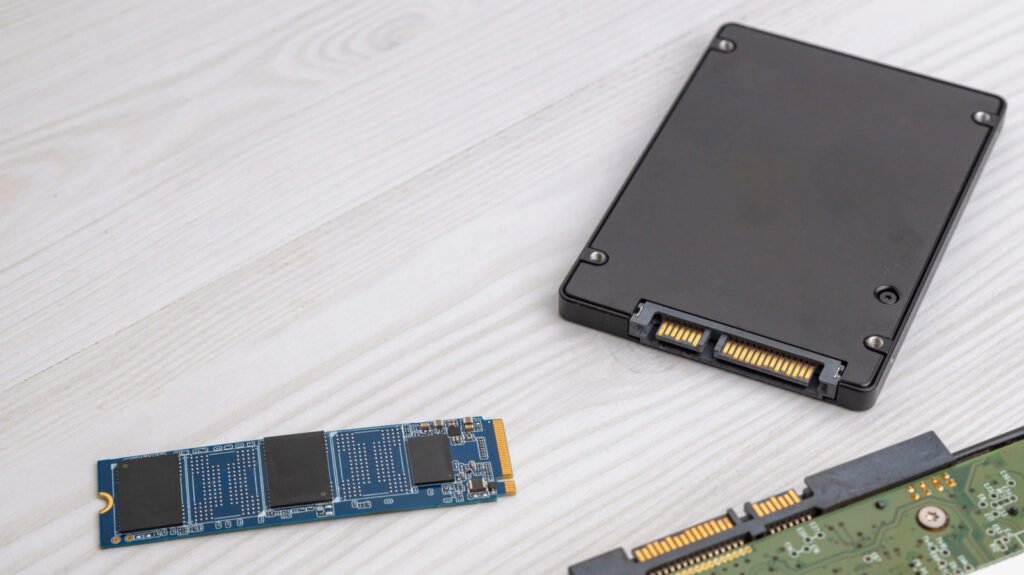
There are a number of variations between NVMe SSDs and a typical SATA SSD or HDD. They’re sooner and carry out higher, sure, however in addition they look completely different. Many assume the small M.2 “gumstick” kind issue to be unique to NVMe drives, however that is a standard false impression with SSDs. An SSD being M.2 does not essentially imply that it is an NVMe.
SATA SSD learn speeds max out at about 550 MBps, whereas a PCIe 5.0 NVMe can attain almost 15,000 MBps. Moreover, an NVMe slot on a motherboard might not help a SATA drive. Because of this, at greatest, you are getting simply above 3% of the efficiency — although most often, you will run into compatibility points and find yourself with a drive you merely can’t use. This is not as massive of an issue because it was, as most main SSD producers have steadily moved away from producing M.2 SATA drives because of low demand. Nonetheless, they’re nonetheless in the marketplace, and sometimes dearer than NVMe drives of an identical capability, which makes it essential to tell apart one from the opposite.
Differentiating between an M.2 SATA SSD and an M.2 NVMe SSD is as straightforward as trying on the specs or the label on the drive itself. Nonetheless, in case you’re uncertain, you can too work out what sort of drive it’s by taking a look at its key notches (the gaps between the golden pins): M.2 SATA SSDs use a B+M key (two notches), whereas NVMe SSDs use an M key (one notch).
SSDs make HDDs out of date
SSDs are a significant enchancment over HDDs, which is why many assume that they make HDDs an out of date expertise. This is not an unfair assumption — they’re considerably sooner, much less susceptible to failure from mechanical shock, and usually extra dependable. Nonetheless, there are a number of causes producers proceed to supply and promote HDDs, and why they’re nonetheless a viable means of storing information.
One of many largest drawbacks to SSDs is that they are considerably dearer than different strategies of storage. As an illustration, a Seagate 1TB exterior HDD prices $119, whereas a 1TB exterior SSD prices $212 — and you may get an HDD for even cheaper on the secondary market. This distinction in value is sensible in case you can leverage an SSD’s larger speeds for sooner loading instances, however you get no additional worth if all you are doing is storing recordsdata long-term.
HDDs additionally present higher longevity and extra dependable storage, as they’re higher at retaining information even when put in a cabinet or storage for years. With an SSD, information is saved electronically, and electrons slowly lose cost. With time, this will result in degradation and lack of information within the type of bit rot. HDDs are additionally weak to mechanical failure and environmental put on, however they are much extra more likely to maintain information for years with out energetic upkeep.
It’s good to defrag your SSD
Defragmentation was a standard means of bettering your drive’s efficiency, so it is sensible why individuals proceed to defrag their drives. Nonetheless, the tactic solely applies to HDDs, and defragging SSDs offers zero profit. Quite the opposite, it may find yourself lowering your SSD’s lifespan.
In an HDD, a mechanical learn head bodily strikes to “fetch” information written on particular elements of the disk. As you erase, overwrite, and add new information, program recordsdata can change into fragmented throughout completely different sectors on the drive far-off from one another, slowing efficiency. Defragmentation fixes this by repositioning these fragments subsequent to one another, making recordsdata complete once more. Knowledge retrieval works in another way in an SSD, because it’s finished electronically. This course of does not use bodily, transferring elements, which is how SSDs handle to be a lot sooner than HDDs.
Fragments of a program close to one another and people farther away require the identical period of time to fetch, making defragmentation pointless. Moreover, since defragmenting rewrites information, it may shorten an SSD’s lifespan through the use of up massive quantities of its TBW (terabytes written) capability — the full quantity of knowledge you may write on an SSD earlier than it dies. As such, avoiding defragmentation can enhance your SSD’s lifespan.
It’s best to take away the sticker on an NVMe drive
Cooling is an integral a part of any PC setup. GPUs and PSUs include built-in cooling followers and heatsinks, whereas a CPU requires a devoted air cooler or liquid cooling rig. Since an NVMe drive does not include directions requiring thermal paste or different cooling options, many customers change into involved over easy methods to handle its warmth.
In the event you’ve by no means used an NVMe drive earlier than, your first intuition upon seeing one could also be eradicating the producer label, as stickers sometimes intervene with passive cooling and entice warmth. Nonetheless, these specific stickers are particularly designed to be non-insulating and are not meant to be peeled off. Typical stickers are primarily product of paper, plastic, or vinyl, all of that are insulators. Nonetheless, the label on an NVMe incorporates a skinny metallic layer that is thermally conductive. As a substitute of trapping warmth, it aids the drive’s skill to chill itself.
Eradicating the sticker in your NVMe is a nasty thought for varied causes. Not solely does it make your drive extra susceptible to heat-related points as a substitute of fixing them, it may additionally void producer warranties. Moreover, you threat damaging the delicate semiconductor chips beneath the sticker by forcing it off, which might render the whole drive unusable.
Blackouts and energy outages harm SSDs
You have probably seen instances of somebody powering their PC on after a sudden energy outage solely to see that their drive has change into compromised, all its information has been erased, and the OS is refusing to work as meant. It is pure to fret about your personal setup from seeing this occur to others — nonetheless, an SSD is way more resilient to put on and fewer susceptible to failure from energy outages.
When an HDD immediately loses energy, the transferring read-and-write head can abruptly cease as a substitute of safely parking, which might make it crash into the platter. That is usually what causes a drive to change into broken and undergo from unhealthy sectors. An SSD has no transferring elements, and shedding energy merely means it shuts down. As such, energy outages not often ever pose a threat of bodily damaging an SSD.
There are nonetheless methods an influence outage will be detrimental, even when it does not outright harm your SSD. As an illustration, in case your desktop laptop shuts down whereas the SSD is writing information, the information being written can change into corrupted. This may imply something from shedding a doc or corrupting app cache to rendering the OS unbootable and in want of an entire reinstall. As such, it is nonetheless price choosing a UPS in case you’re in a area susceptible to energy outages.