First-ever large-scale oyster reef restoration in MA – NBC Boston
Summer season O’Rourke has spent the previous 5 hours counting oysters with no lunch break. Utilizing a pair of expensive digital calipers she introduced from house, she dutifully measures every bump and cluster, dismissing muck, sand, and the occasional mud crab to get an correct learn of the shellfish’s progress.
O’Rourke wears gloves, however it would not seem like she wants them — she grew up taking part in with the lobsters her dad introduced house. “He’d yell at me to place the rubber bands on [their claws], however I knew how you can maintain them,” O’Rourke stated. “And I nonetheless have all my fingers.”
Her work takes place on a ship within the neck of the Westport River, the place Massachusetts Division of Marine Fisheries researchers are conducting the first-ever large-scale oyster reef restoration. In October, O’Rourke, a DMF seasonal technician, and a group of scientists and volunteers canvassed the underside of the longer term restoration websites to get a baseline of what number of oysters had been already there.
It is sluggish, meticulous work — however it’s integral to figuring out if their efforts ever show profitable.
A whole lot of years in the past, oyster reefs dominated the Jap Seaboard, offering essential habitat for coastal species at a scale rivaling the coral reefs. 1000’s of acres of reefs have been destroyed over the previous 500 years, by means of overharvesting and the onslaught of fertilizer, sewage, and sediment.
In 2024, the Massachusetts Division of Marine Fisheries and the conservation nonprofit The Nature Conservancy acquired a five-year federal grant to attempt to carry them again.
Though large-scale restorations have proved profitable within the Chesapeake Bay area and are underway in states like New York and Rhode Island, that is the primary restoration of its sort in Massachusetts.
DMF Habitat Restoration Specialist Sean Terrill admits there is a sure degree of guesswork concerned.
“We’ll simply must see what occurs,” Terrill stated.
Oyster catchers
No statewide regulatory physique manages shellfishing grounds in Massachusetts. To get permission to seed wild oysters within the state’s waterways, Terrill and his companions at The Nature Conservancy needed to go city to city for approval, pitching restoration websites in Westport, Fairhaven, Mashpee, and Bourne.
With 60 acres of proposed oyster reef, the Westport River is the most important of the proposed websites and the “flagship” mission for oyster restoration, Terrill stated.
That is as a result of the Westport River, with its vast mouth and brackish waters shielded by harsh currents, presents splendid circumstances for oyster rising. If the currents are too robust, the oyster larvae will not set up on the river flooring. If the underside is simply too muddy, as with some freshwater areas, the oysters may get buried.
“There was tons of of acres of oyster reef habitat there,” Terrill stated. “It simply meets lots of standards for being a very good place for restoration.”
On Oct. 15, Terrill and his group, accompanied by O’Rourke, Westport River Watershed Alliance Science Director Roberta Carvalho, and others, took to the Westport River to depend oysters.
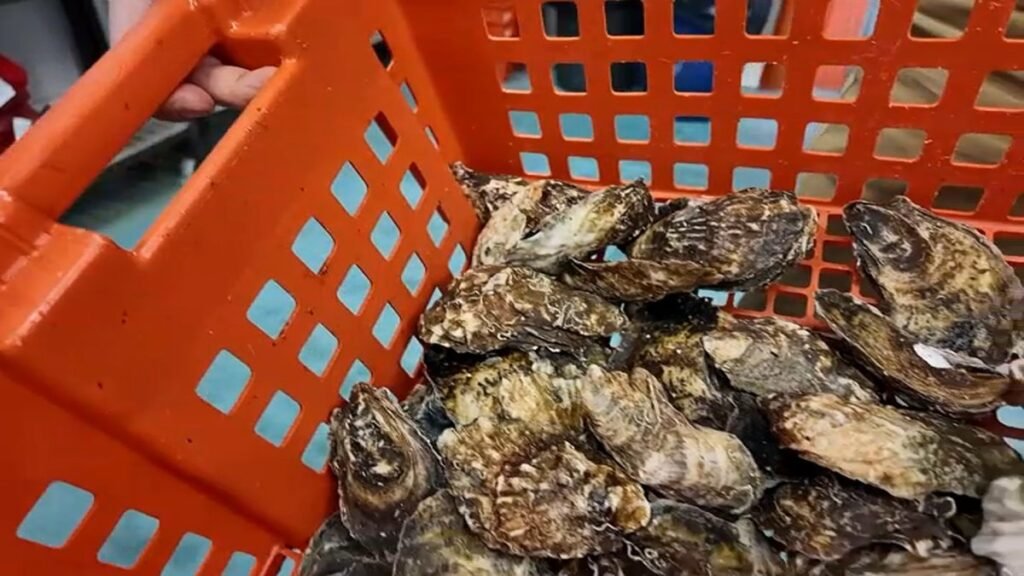
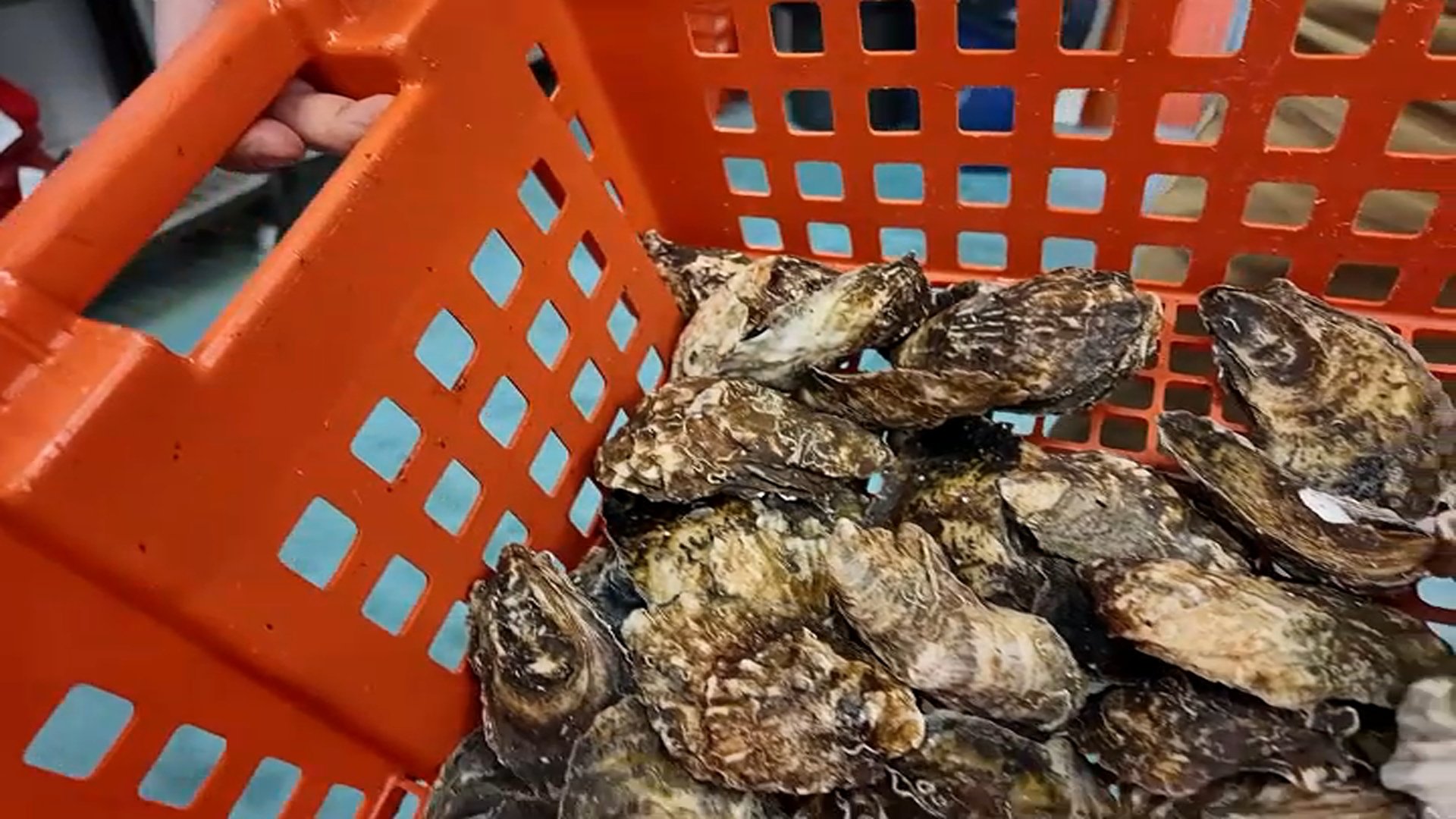
DMF’s habitat group suited up into scuba gear to retrieve oysters from the riverbed whereas O’Rourke and Carvalho counted and measured every one. After seven hours on the water, they counted tons of of oysters.
Terrill and his group are nonetheless finalizing the info gathered from that day, however he was pleasantly shocked to see the oysters thriving even in areas open to leisure shellfishing.
Cultch Metropolis
Within the spring, Terrill and his group will seed the longer term reef websites with “cultch,” or discarded oyster shells, to create a rocky atmosphere that the oyster larvae can latch onto.
Oyster shells aren’t all the time straightforward to get their fingers on. Nonprofits just like the Massachusetts Oyster Challenge assist fish markets and seafood eating places recycle their oyster shells for aquaculture and tasks like these, however the overwhelming majority of shells nonetheless find yourself in landfills, Terrill stated.
As soon as the cultch is about, scientists lay down the spat-on-shell, a mixture of oyster larvae and shells. With a bit of luck, the reefs will self-populate over time and the brand new larvae may even journey to and from neighboring reefs.
“We will be form of connecting the dots,” Terrill stated. “The reefs that we’re restoring are going to start out producing larvae, and so then we may restore even additional downstream, and hopefully simply create a meta inhabitants throughout the system which can be all exchanging larvae and rising genetic range.”
Terrill remains to be figuring out what true success will seem like. Within the Chesapeake Bay area, the usual for a profitable oyster reef is 50 oysters per sq. meter. However a few of the areas Terrill’s group surveyed in Massachusetts in October have already got tons of of oysters per sq. meter.
In the long run, Terrill hopes to revive 2,500 acres of oyster reefs by 2050. It is a small step in direction of rectifying the 1000’s of acres misplaced over the previous 5 centuries.
In flip, the reefs will home fish and different species, and the oysters will assist enhance water high quality by pulling nitrogen out of the river and driving extra carbon into the soil.
“The necessity is to revive a severely degraded wild species, and by doing that, carry again all the ecosystem advantages that it offers,” Terrill stated.
___
This story was initially revealed by The New Bedford Mild and distributed by means of a partnership with The Related Press.