
Star Trek’s Non-Corporeal Aliens Defined
Welcome to Trekspertise, a collection the place we break down the expertise, historical past, particulars, and selections that make the Star Trek universe so advanced — and so enjoyable.
One of many main options of “Star Trek” is theoretical biology. Given the huge panoply of alien species on show all through the franchise, audiences have been invited to ponder alternate evolutionary paths apart from the one which occurred to convey us into being on Earth. What sort of planetary situations can be required to type, say, a hyper-intelligent crystalline being? How did a horta evolve? What’s going to we evolve into sooner or later? Will our brains adapt to grow to be psychic over time? In line with the “Star Trek: Voyager” episode “Threshold” (one of many present’s most outraging to followers), it was revealed that people will finally evolve into large salamanders.
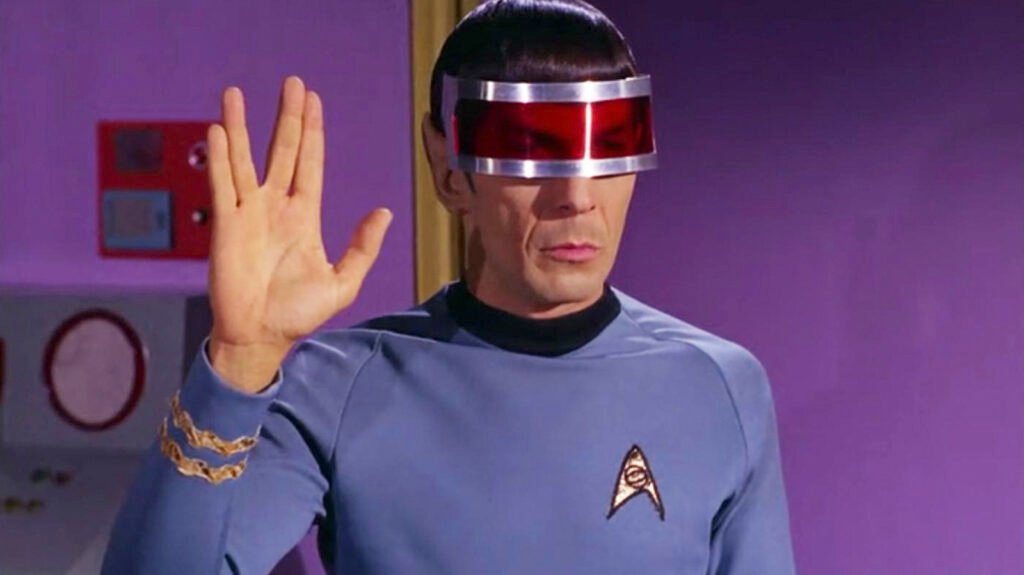
This leads to a couple logical evolutionary extremes, like the truth that some species on “Star Trek” have developed into beings of pure vitality. “Star Trek” has many examples of non-corporeal aliens who can solely be perceived as gentle, as a psychic presence, as a sound, or as a imaginative and prescient beamed immediately into our inferior, corporeal brains. To quote a notable instance: Within the unique collection episode “Is There In Reality No Magnificence?,” audiences have been launched to the Medusans, a extremely smart, telepathic, and empathic species whose light-constructed our bodies are so wildly advanced that any human taking a look at them would immediately go mad. Solely a mentally disciplined species just like the Vulcans may have a look at a Medusan, and even then required a particular filtered visor (pictured above).
These sorts of aliens develop the viewers’s thoughts as to what will be thought-about life.
It is life, Jim, however not as we all know it
In taking a look at fictional non-corporeal species, “Star Trek” expands our horizons. We’re invited to ponder new views about primary ideas like evolution, time, the character of consciousness, and, maybe, our personal relationship to the cosmos. Non-corporeal entities are one of many coolest concepts “Star Trek” has to supply, and their recurring nature is a continuing reminder that life is extra advanced, and the cosmos extra ineffable, than we may ever hope to think about.
On “Star Trek,” non-corporeal aliens have a tendency to look as lights or clouds or glowing mists of vitality. One may recall the smoke-like alien that made Kirk nervous within the episode “Obsession,” one of many extra underrated episodes of the present. Others may instantly consider Zefram Cochrane’s glowing, cloud-like “companion” within the episode “Metamorphosis.” That entity had the power to form of intuitively talk with Cochrane (Glenn Corbett), and will additionally heal ailments and maintain human life past its common organic obstacles. A standard theme of non-corporeal entities on “Star Trek” is that they’re godlike and highly effective, capable of faucet into the powers of the universe in methods we do not perceive.
The Medusans could also be one of the fashionable non-corporeal entities on “Star Trek,” however followers of “Deep Area 9” would absolutely need me to acknowledge the wormhole aliens, a.okay.a. The Prophets. In that present’s pilot episode, “Emissary,” Benjamin Sisko (Avery Brooks) travels right into a secure wormhole and encounters bodiless creatures who can solely talk with him by showing as folks from his reminiscences.
Non-corporeal life types are frequent on Star Trek
The wormhole aliens from “Deep Area 9” are so, effectively, alien, they do not perceive ideas like linguistic communication or linear time. They do not see trigger resulting in impact, however fairly a widespread collection of occasions that occur suddenly. Sisko has to do the unimaginable, and clarify the human behavior of seeing time as a straight line.
And, after all, there are various species of godlike beings on “Star Trek” who typically take the type of people, regardless of not having bodily our bodies. Q (John de Lancie) from “Star Trek: The Subsequent Technology” is one in every of these beings, as is Trelane (William Campbell) from the unique collection. These two beings are likely to see corporeal people as lesser species and amuse themselves by taunting and enjoying with them. Much less whimsical is Kevin Uxbridge (John Anderson), a member of a robust vitality species referred to as the Douwd. Kevin took the type of a human, married, and witnessed his spouse killed, main him to, in a second of ill-temper, commit on the spot galaxy-wide genocide of a single species. He is the deadliest character in all of “Star Trek.”
The listing goes on. Q tormented the Calamarain, which exist as ionized fuel. There are the Organians, the Lights of Zetar, and the godlike Metrons, the latter of whom oversaw the battle between Kirk (William Shatner) and the Gorn within the episode “Enviornment,” and loads of different examples. Typically, non-corporeal entities are to date past human expertise, it is troublesome to speak with them, a lot much less come to some sort of diplomatic understanding.
However typically non-corporeal entities do grow to be our buddies. On “Star Trek: Prodigy,” the character of Zero (Angus Imrie) is a Medusan who managed to assemble a robot-like car for themselves, permitting them to work together with us flesh-beings with out exposing themselves. Generally the ineffability of the cosmos works in our favor.