Black academics say college students name them the N-word. LAUSD vows to show them to not

One trainer reported that the N-word was written on the classroom wall for the fifth consecutive yr.
One other trainer’s inbox contained the message: “I actually hate you, [N-word]. Black is ugly, and so are you.”
A pupil addressed a trainer by shouting “silly [N-word] 4 instances,” however when the trainer issued a two-day suspension, the principal returned the scholar to the classroom with no penalties, in line with an account shared at a web based discussion board over the summer time.
After complaints akin to these from Black academics about college students routinely hurling racist insults, particularly the N-word, the Los Angeles Unified Faculty District will strengthen measures to trace such incidents and reply to them.
Too typically, say academics and advocates, nothing occurs. Or worse, academics are reprimanded or face retaliation for being complainers, akin to being written up or getting worse class assignments.
College students, too, are focused with racist language.
“Black college students … have advised me that they’ve been known as the N-word, a monkey and different degrading names,” Shelly Castillo, a San Fernando Center Faculty historical past trainer, mentioned at Tuesday’s college board assembly. “They don’t report it loads as a result of they haven’t been believed, and so they’ve been focused or remoted.”
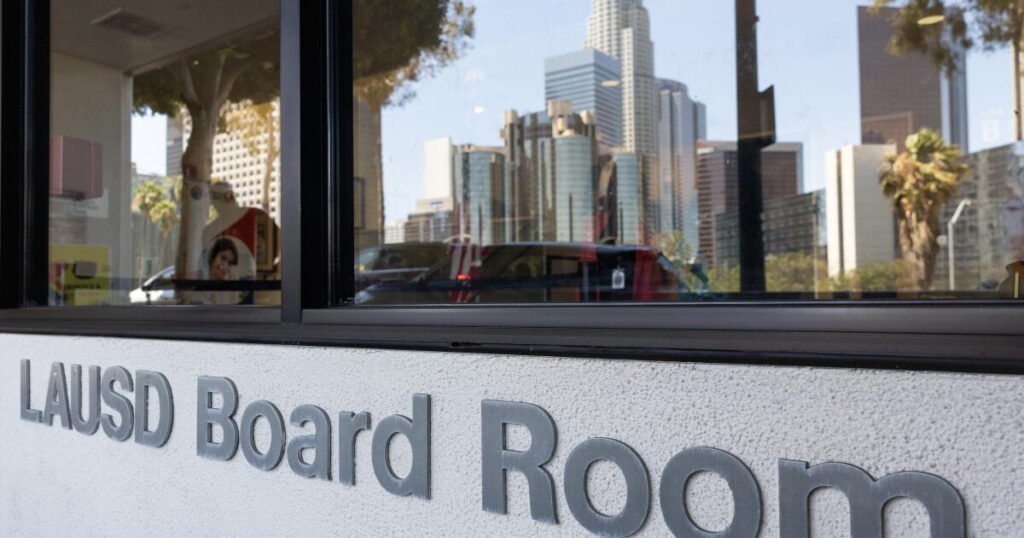
Citing “the centuries-long legacy of anti-Black racism, violence, discrimination, and intimidation,” the Board of Schooling unanimously handed a decision Tuesday calling for heightened pupil counseling associated to the N-word and different hate speech, in addition to employees coaching on responding to the incidents and reporting them. And employees should report again to the board in March on the progress made.
The decision, which was introduced ahead by board members Karla Griego, Sherlett Hendy Newbill and Kelly Gonez, grew out of conferences that Gonez held with advocates. LAUSD’s pupil inhabitants is about 7% Black.
“I’ve been in dialog with Black educators in my board district for over a yr, and I need to simply acknowledge that they’re right here within the room with us,” Gonez mentioned. “And I so respect their urgency — that despite the fact that we’ve sturdy insurance policies and protections in place, we would have liked to do extra.”
The N-word has come up lately at Los Angeles Metropolis Corridor. In July 2025, the Metropolis Council banned the N-word and the sexist vulgarity often called the C-word throughout public remark. A lawsuit over free speech has challenged that rule.
The difficulty at faculties is considerably totally different. College students on grade-school campuses have free speech rights however they’re extra restricted than for adults. And faculties have broad powers to deal with bullying and mete out punishment.
Many N-word incidents
On the July public discussion board, Rev. James Thomas learn aloud accounts associated by academics.
“Three male college students got here to my door throughout diet and known as me the N-word and a black B,” one trainer recounted. “The N-word [was] written on my desk. I launched myself to the category, and a pupil yelled out [N-word] 3 times.”
When the trainer reported the incident, the administrator was unwilling to take motion, in line with the account.
“As a Black man from prime to backside, I don’t like when individuals attempt to clarify what we’re coping with. So I’m right here to let you know right here and now: The [N-word] will not be acceptable,” Bruce Gerard Brown Jr., who teaches a number of topics at San Fernando Excessive Faculty, advised the college board Tuesday. “Let’s not relegate it to a nasty phrase. It’s a slur.”
In her feedback to the college board, Denisha Jordan recounted racism, together with the N-word, that she endured each as a toddler and as a trainer. She mentioned her daughter had related experiences: “Just like the time when she advised me a few joke that she heard in class. ‘How do you save a Black child from drowning? You don’t.’”
Decision a place to begin
A coalition of teams, together with Black Educator Advocates Community, Group Coalition, Watts of Energy Basis and Black Trainer Venture, wrote in help of the decision: “Black academics and college students deserve to show and study in environments the place their identities are revered, their dignity is protected, and their security is prioritized.”
However the last model of the decision was weaker than some advocates wished.
For one factor, it focuses on hate speech of all types, considerably echoing language in present district insurance policies. It primarily addresses hurt to college students and says comparatively little about educators.
Additionally, makes an attempt to carry college students accountable are totally throughout the context of the district’s “restorative justice” strategy to self-discipline and its coverage to just about eradicate suspensions. In restorative justice, college students are speculated to study why their actions had been inappropriate and, ideally, make amends. However they don’t essentially face outright punishment.
“This could not open the door for punitive actions in opposition to our college students,” board member Griego mentioned. “College students should be educated to be able to perceive the implications and hurt of particularly the usage of the N-word and different racial slurs.”
Board member Tanya Ortiz Franklin proposed household workshops to elucidate why the phrase is handled as hate speech in class.
Hendy Newbill, the board’s solely Black member, pledged that the decision wouldn’t be empty rhetoric.
“When an incident occurs, there should be a response,” she mentioned. “When a coverage will not be adopted, there should be accountability. And after we determine an issue, there should be follow-through.”